Report 3TermitesQueensland’s species, by district
Termite species in Queensland
Business Queensland names Coptotermes as the most economically important and widespread subterranean termites in Queensland, and the giant northern termite, Mastotermes darwiniensis, as the most destructive. Coptotermes acinaciformis occurs throughout the state, while the giant northern termite is confined to the tropical north.
General information, not building advice. The species, places and rules here are Queensland’s, from Business Queensland and the Queensland Government’s two termite fact sheets, listed at the foot of this page.
Most termites never touch a house
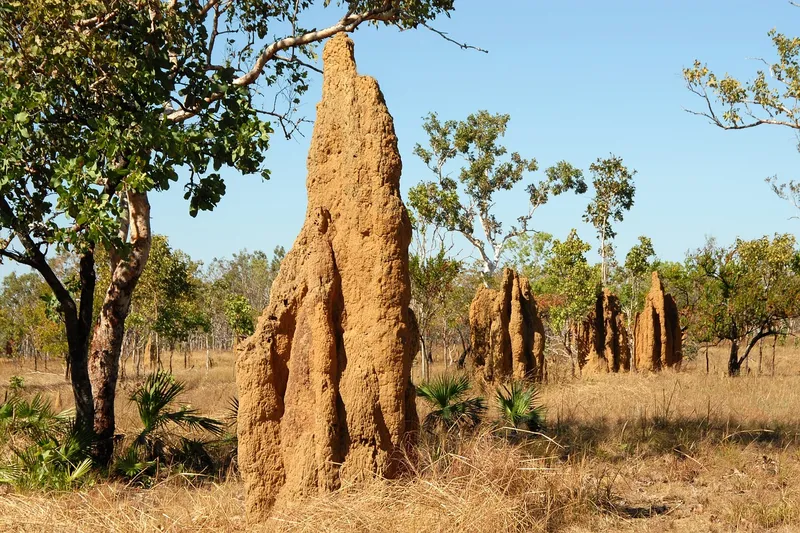
Many termite species eat grass, and only a few matter to timber in buildings, the Queensland Government’s fact sheet says. About ten native subterranean species damage timber in Queensland. A termite mound in a paddock is not automatically a threat to the house either: many mound-building and tree-nesting termites in urban areas do not infest sound, seasoned timber.
The ones that do damage houses, furniture and other timber products are of two kinds: subterranean termites, which need soil or another constant source of moisture, and drywood termites, which need only the moisture in the timber.
The damaging species, and where in Queensland
| Species | Kind | Where in Queensland | Of note |
|---|---|---|---|
| Coptotermes acinaciformis | Subterranean | Throughout Queensland | One of the three most damaging subterranean species. |
| Schedorhinotermes species | Subterranean | Throughout Queensland | Also among the three most damaging. |
| Mastotermes darwiniensis (giant northern or Darwin termite) | Subterranean | Tropical northern Queensland and northern Australia | Attacks growing trees, shrubs and vegetables as well as timber. Soldiers grow up to 13 mm. |
| Cryptotermes primus (native drywood termite) | Drywood | Throughout Queensland | Native. |
| Cryptotermes brevis (West Indian drywood termite) | Drywood | Listed as throughout Queensland | Introduced; the world’s most destructive drywood termite. |
| Cryptotermes cynocepalus (Indo-Malaysian drywood termite) | Drywood | Around Cairns and further north | Introduced. |
| Cryptotermes domesticus (domestic drywood termite) | Drywood | Around Cairns and further north | Introduced. |
| Cryptotermes dudleyi | Drywood | Thursday Island | Introduced. |
Two Business Queensland pages describe the West Indian drywood termite’s range differently. The species page above lists it as throughout Queensland; the page given to that termite says it is established in Maryborough and many Brisbane suburbs, and present in Bundaberg, Townsville and Rockhampton. Both are Queensland Government pages; read them together.
More names for southern Queensland
The Queensland Government’s 2019 fact sheet goes further than the species table. Besides the two most serious pests, the species it says commonly damage timber are Schedorhinotermes actuosus, S. breinli, S. intermedius and S. seclusus, and Nasutitermes exitiosus.
Two more Coptotermes, C. frenchi and C. lacteus, also occur in southern Queensland. The fact sheet says C. lacteus builds mounds usually associated with stumps, and feeds mainly on decayed wood.
What black soil changes, and what it does not
Soil appears to have an important influence on where termites live in Queensland, the fact sheet says, and heavy soils such as the black earths of inland Queensland, which crack deeply and widely when dry and waterlog after rain, “do not favour termite survival”. In the same passage it says species that damage timber in buildings occur throughout the state, and that in practice any structure containing wood is exposed to possible attack, out in the country included, unless protective measures are taken.
The scale of a colony
- 2,000
Eggs a day that some subterranean termite queens can produce.
- 2 million
Individuals a mature colony may number, and it may last as long as 50 years.
- 1 ha
The food-gathering reach one colony’s galleries can give it, with single galleries up to 50 m long for most species.
- 100–200 m
How far a single gallery of the giant northern termite may run.
How an expert tells one species from another
Correct identification takes skill and experience, and the termites need to be viewed with a hand lens or a microscope of at least tenfold magnification. Business Queensland says the size and build of the soldiers, where the termites are, their nesting habits and their damage all help to identify a species.
The soldier is the key. The fact sheet calls the soldier caste the most distinctive and the easiest to identify a species from, with heavily armoured and pigmented heads. Some soldiers have prominent jaws; others have a pronounced snout. Like the workers, soldiers are wingless, sterile and blind. Subterranean termites are generally 3–7 mm long and pale brown or brown.
When a species is a matter for Biosecurity Queensland
Exotic Coptotermes species are prohibited matter under Queensland’s Biosecurity Act 2014, and anyone who thinks they have seen them must report it immediately; Business Queensland gives an online form and phone numbers on its subterranean and drywood termites page. Otherwise, Business Queensland says, “All other subterranean and drywood termites are not listed as prohibited or restricted matter”, but everyone has a general biosecurity obligation to take reasonable and practical steps under their control to minimise the risks.
Timbers that resist, and none that are immune
Business Queensland names timbers naturally resistant to termites: native cypress pines, narrow-leaved and broad-leaved red ironbark, turpentine and satinay. The Queensland Government’s fact sheet on termites in buildings adds the caution: several timbers have resistant heartwood, “However, no species is immune.” The roof report turns to the larger animals that get into a house.